
PH STUDIES WORKSHOP IN LISBON DEEPENS PH-PORTUGAL DIALOGUE, HIGHLIGHTS GENDER AND SOCIETY
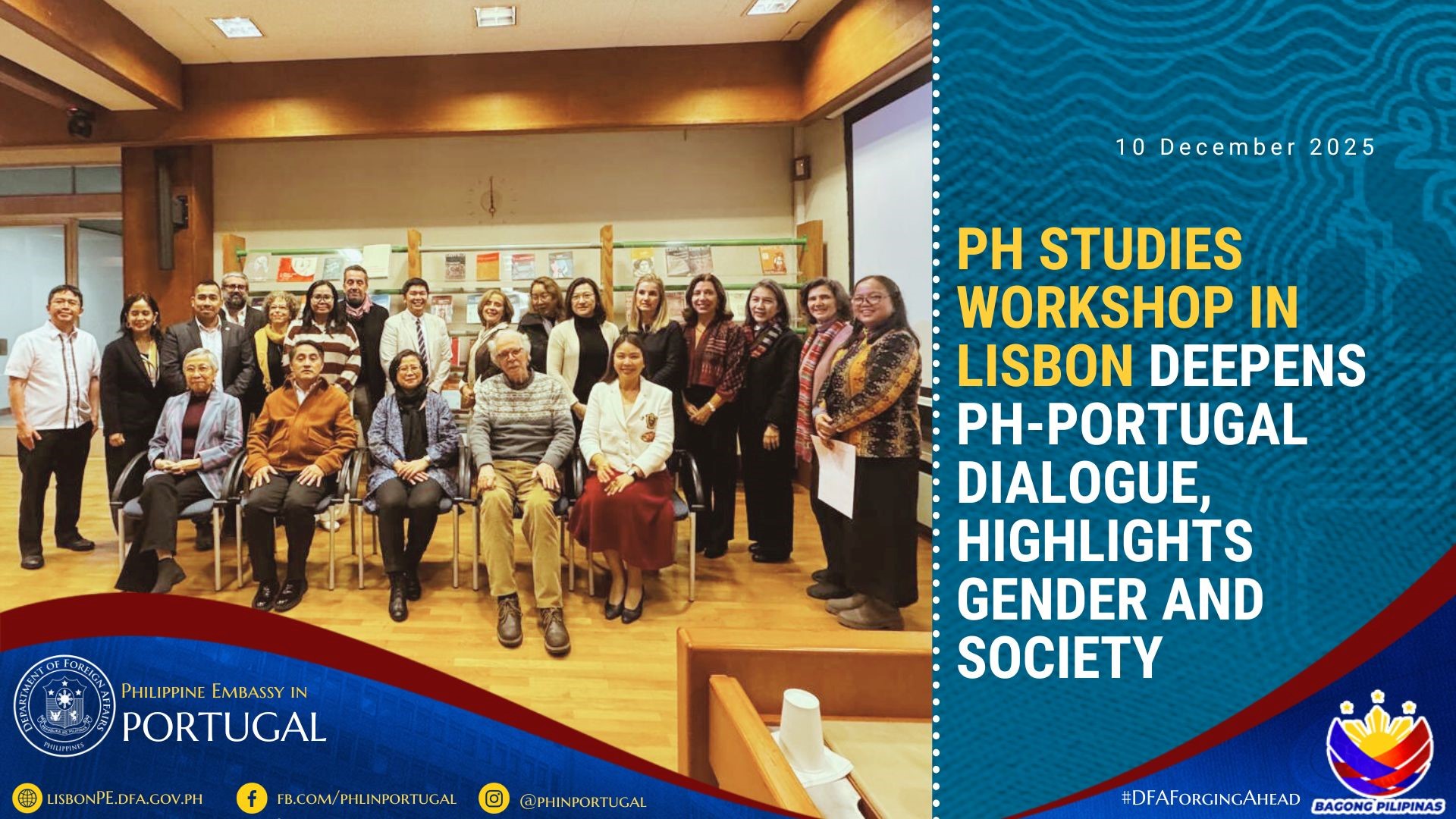
Lisbon, Portugal, 11 December 2025 – The two-day international Philippine Studies in Portugal workshop concluded on 10 December 2025 at the Biblioteca Nacional de Portugal, drawing university professors, scholars, diplomats, and members of the Filipino and Portuguese public. The workshop’s second day covered a series of paper presentations on transnational mobility, the enduring legacies of colonial history, and contemporary avenues of collaboration in history, diplomacy, education, and economics.
The second day of the workshop, “Sea of Stories: Exploring Waves of Influence and Winds of Change in the Euro-Asian Nexus,” involved discussions of the Philippines’ dynamic connections with Portugal and the broader global community.
Dr. João Paulo Costa of the Universidade Nova de Lisboa opened his keynote presentation with a historical world map from the era of the Portuguese Empire, one in which the Philippines was notably absent. He explained how early Portuguese narratives framed Portugal as the first global power, and traced the rise of global trade systems and the Philippines’ strategic role through the Manila–Acapulco Galleon Trade that linked the world’s various continents.
Panel discussions at the workshop spanned diverse themes, including non-traditional student mobility with a focus on African enrollment in Philippine universities, limited trade and labor exchanges between the Philippines and Portugal, and Macau’s historical role in cultural and commercial ties. Other presentations explored European digital diplomacy concerning the South China Sea conflict, Davao’s abaca-driven transformation, and five centuries of French-Filipino scientific engagement.
Several presentations focused on women and gender, examining how gender shaped historical experience, knowledge production, and political agency. Presentations analyzed American women’s travel journals from the early twentieth century, showing how sensory descriptions of daily life, domestic spaces, and colonial society offered perspectives absent from official records. Other papers traced the development of girls’ education in the Philippines, noting the gradual expansion of schooling for women from the mid-nineteenth century and its long-term social effects. A separate discussion compared reproductive rights in Catholic democracies, focusing on the Philippines and Timor-Leste. Speakers examined women’s agency, church influence, constitutional constraints, and public health debates, highlighting how differing political contexts produced sharply divergent outcomes despite shared religious traditions.
Ambassador Paul Raymund P. Cortes commended all the historians of the workshop and stressed in his closing remarks, “We have wonderful academic professionals who we should listen to and this is exactly why we need to come up with these interactions even on a yearly basis ...this should definitely feed into foreign policy.”
The Philippine Embassy co-organized the workshop with Dr. Stephanie Marie R. Coo under the Philippine Studies Program in Portugal, in partnership with the Faculty of Social and Human Sciences of the Universidade Nova de Lisboa, led by Dean Alexandra Curvelo, and Ateneo de Manila University, under Dr. Czarina Saloma-Akpedonu, Dean of the School of Social Sciences.
The Philippine Studies Program in Portugal remains committed to strengthening academic exchange, advancing cultural understanding, and deepening engagement between the Philippines, Portugal, and the broader global community. END