
PHILIPPINE STUDIES WORKSHOP SHOWCASES BOOKS ON THE PHILIPPINES AND LUSOPHONE WORLDS, HONORS NATIONAL HERO AHEAD OF RIZAL DAY
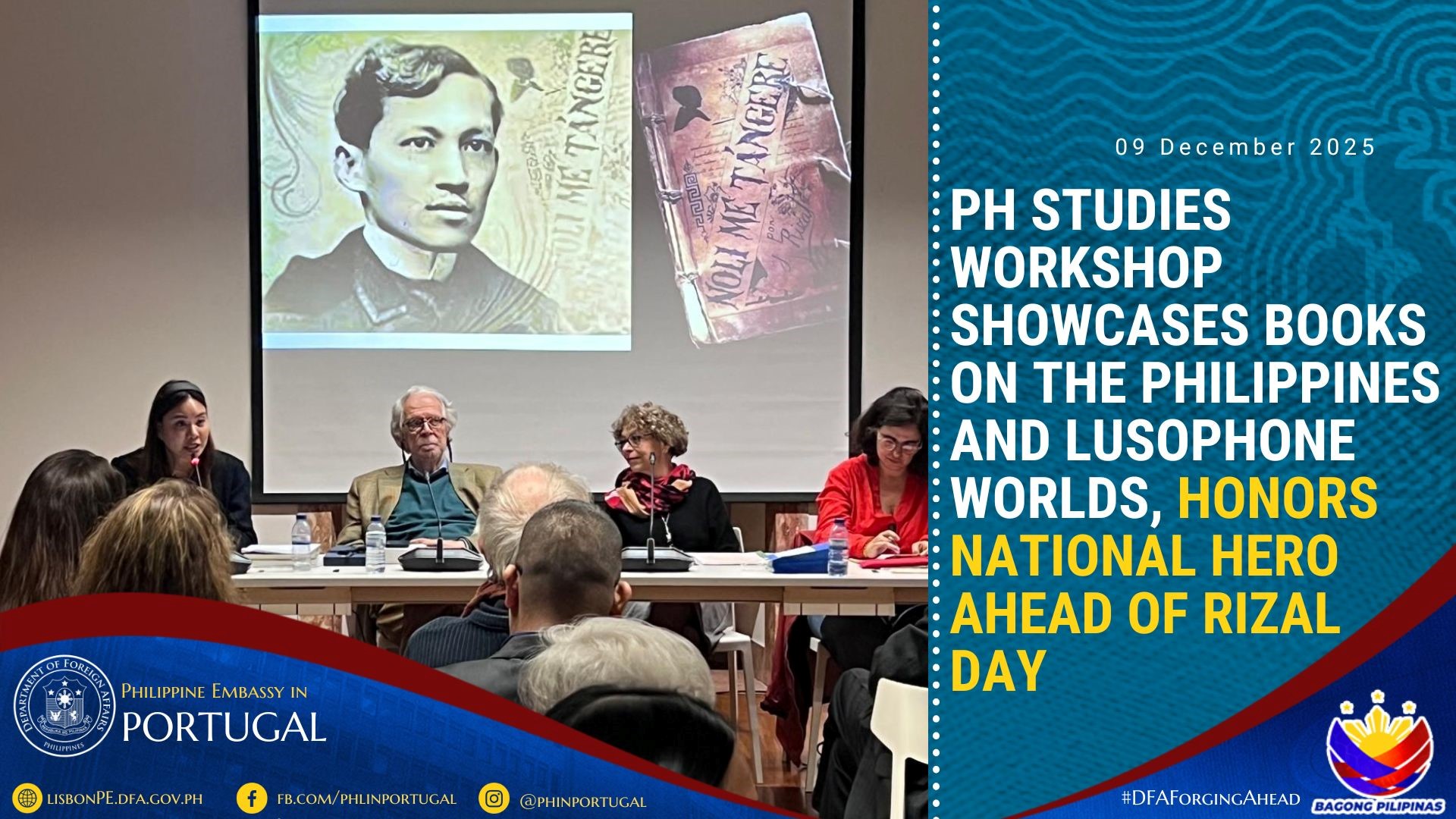
Lisbon, 9 December 2025 — Philippine, Portuguese and other European scholars gathered on 9 December 2025 at the Biblioteca Palácio Galveias in Lisbon for a full-day presentation of books and other publications on Philippine history and the contemporary Global South, spotlighting connections across Asia and Europe and strengthening the Philippines’ visibility in Lisbon’s academic and cultural scene.
Entitled “Sea of Stories: Exploring Waves of Influence and Winds of Change in the Euro-Asian Nexus,” the workshop’s book presentation segment featured nine publications and drew over 70 participants, including Philippine and Portuguese scholars, diplomats, and members of the Filipino, Portuguese, and Brazilian communities.
The first session explored historical figures shaped by colonial encounters, archival research uncovering early Philippine references in Portuguese sources, and sociological studies of urban communities navigating transitions from poverty to middle-class consumption. The second session examined colonial medicine, economic histories, and environmental activism in Angola, Goa, and Batangas, emphasizing local agency, knowledge exchange, and community resilience in addressing structural inequalities and global economic pressures.
In his keynote, Prof. Armando Marques Guedes of the Universidade Nova de Lisboa School of Law framed José Rizal as a Humboldtian scholar whose intellect embodied the curiosity and synthetic knowledge of Alexander von Humboldt and Dom Pedro II, the last Emperor of Brazil. Rizal mastered languages, medicine, natural history, arts, and social sciences in Europe, using knowledge to understand the world and the Philippines within 19th-century geopolitics. Prof. Guedes noted that Rizal was “more European than the Europeans in the Philippines,” yet this very intellect made him a threat to colonial power, ultimately leading to his execution.
The final session highlighted Rizal’s complex intellectual legacy, including the challenges of the Portuguese translation of Noli Me Tangere and his nuanced approach to reform and nation-building. Dr. Stephanie Marie R. Coo, the lead organizer of the workshop, presented her new book entitled Seams of Sedition: Sartorial Symbols in Rizal’s Noli Me Tángere, which examines how clothing and material culture in the novel reveal social hierarchies, colonial power dynamics, and Filipino responses to Spanish rule, linking sartorial detail to broader political, economic, and cultural currents of 19th-century Philippines.
Ambassador Paul Raymund P. Cortes praised the Portuguese translation of Noli Me Tangere, stating that it “dismantled the linguistic walls of humans so that the Filipino identity and perspective were reintroduced to the Portuguese train of thought.” He also underscored the importance of decolonizing shared history, challenging academics to turn discussions into knowledge that resonates beyond scholarly circles, stating “It has to be something that someone, like Tom or João, will understand, and this is our challenge, to make sure that at the end of the day, it actually means something to people who matter.”
The book presentation segment is part of the Department of Foreign Affairs’ Philippine Studies Program in Portugal, which seeks to deepen understanding of Philippine history, culture, and society while fostering academic collaboration between Filipino and Portuguese scholars. The Philippine Embassy’s initiative is supported through partnerships with Ateneo de Manila University, Universidade Nova de Lisboa Faculdade de Ciências Sociais e Humanas and its Centro de Humanidades, and the Foundation for Science and Technology. END